

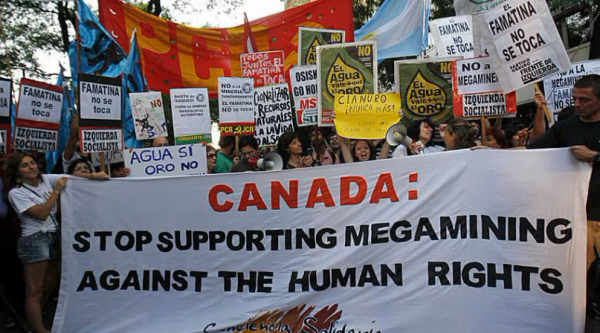
Widespread well-documented human rights abuses have been associated with the activities of many Canadian mining companies abroad. Not surprisingly, women are disproportionately affected by human rights abuses in mining communities, including:
- Gender-based violence
- Seizure of land and water without local consultation
- Serious illness or death resulting from toxic chemicals in the air, land and water
- Injuries or death of peaceful protesters
- Destruction of cultural values and the social fabric of communities
Ombudsperson for Responsible Enterprise (CORE)
Since 2019, Canada has had an office of the Ombudsperson for Responsible Enterprise (CORE), which receives complaints about human rights abuses tied to Canadian corporate activity abroad in the mining, oil & gas, and garment sectors. However, the CORE does not currently have the legal powers it needs to do its job effectively. As a member of the Canadian Network on Corporate Accountability (CNCA), GRAN advocates for the Canadian government to give the CORE the powers necessary to hold Canadians companies accountable for the environmental and human rights impacts of their global operations.
Deep-Sea Mining
GRAN is a member of the Deep Sea Conservation Coalition, a coalition of national and international organizations concerned about the severe and potentially irreversible risks of deep-sea mining on the environment, its impact on human rights, and the long-term implications for bio-diversity, clean water, and food security. According to a recent UN policy brief, deep-sea mining threatens the human rights to life, health, food, culture, and a clean, healthy, and sustainable environment of all on this planet, and disproportionately threatens the rights of Indigenous Peoples, small-scale fishers, and coastal communities whose survival, livelihoods, and cultural identity depend on healthy marine ecosystems.
